Good Karma: A Handwritten Font That Feels Like Home
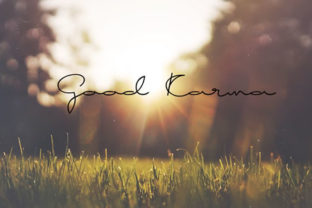
It started with a candle—just one, sitting on my workbench beside a half-printed label and a stack of kraft paper tags. I’d been testing fonts all morning for our new lavender-vanilla scent, and nothing quite landed. Too stiff. Too fussy. Too… not us. Then I opened Good Karma, typed “Breathe Deeply,” and paused. There it was—the gentle slope of the lowercase g, the soft lift at the end of the a, the way the letters lean into each other like friends sharing a secret. This wasn’t just another script font. It was warmth in typeface form.
Good Karma is a cursive handwritten font designed by Roland Hüse—and it shows. Every curve feels intentional but unhurried, every connection natural rather than engineered. It’s not overly ornate or theatrical; instead, it carries quiet confidence, sincerity, and approachable elegance. Think inked journal entries, chalkboard menus at your favorite local café, or the careful handwriting on a thank-you note tucked inside a gift box. As a script font in the Script Amp category, it’s built for presence—not background noise.
I’ve used Good Karma across so many real product moments: printing matte-finish candle labels that hold up to essential oil residue, cutting vinyl for farmhouse-style wall signs, laying out printable wedding welcome boards for a client’s backyard ceremony, and designing seasonal sticker sheets for planner lovers. It shines brightest where personality matters—on boutique tags tied to ceramic mugs, on cotton tote bags meant to be carried daily, or as the hero text on digital download covers for gratitude journals and habit trackers.
What makes Good Karma especially useful for makers is its balance of charm and clarity. Unlike some ultra-decorative scripts, it reads cleanly even at small sizes—say, 10pt on a 1.5-inch product tag or 14pt on a printed greeting card. For Cricut and Silhouette users, it cuts beautifully when converted to outlines (always double-check your software’s compatibility), and its consistent baseline means no awkward floating letters on die-cut stickers. On physical merchandise—like heat-transfer vinyl on t-shirts or ceramic decals—it retains its organic flow without pixelation or distortion.
That said, Good Karma isn’t meant for paragraphs. It’s a display font, best reserved for names, titles, short phrases, quotes, and decorative headings. Use it for “Hand-Poured Since 2021” on your packaging, “You’re Invited” on a wedding suite, or “Joyful Moments Only” on printable wall art. Let it breathe. Pair it thoughtfully: a clean sans serif like Montserrat or Poppins for body text keeps things grounded, while a subtle serif like Merriweather adds quiet sophistication for invitation suites. Avoid pairing it with another busy script—let Good Karma be the voice; let the supporting font be the steady hand holding the mic.
In practice, this looks like:
- A holiday candle line using Good Karma for scent names (“Cinnamon Hearth,” “Snowfall & Sage”) alongside crisp Helvetica for burn instructions and ingredients
- Printable planner pages where Good Karma headlines monthly goals, while a light-weight sans handles checkboxes and notes
- Digital download previews styled with Good Karma on mockups—think a rustic wooden sign background with “Grateful Heart” in soft charcoal, then layered over a clean white PDF thumbnail for Etsy listings
- Wedding stationery where Good Karma introduces names and dates, while a classic serif handles RSVP details and venue directions
Before you drop Good Karma into your next design, take five minutes to explore what’s included. Does it offer alternate characters? Swashes for flourishes on initials? Ligatures that improve letterflow in words like “love” or “forever”? Check the file formats—OTF and TTF are standard, but some versions include WOFF for web use if you’re building a shop site. And always confirm commercial licensing: yes, Good Karma is licensed for physical products, digital templates, SVG files, and merchandise—as long as you’re using it as part of your original design (not reselling the font file itself).
Typography is never just decoration. When customers see Good Karma on your candle label, they don’t just read the scent name—they feel intention. When they open your printable bundle and spot that graceful “Welcome” header, they sense care. When they hold your wedding invitation and trace the curve of the couple’s names with their eyes, they’re already emotionally present. That’s the quiet power of a well-chosen handwritten font: it builds trust before a single word is spoken.
And because it’s rooted in authenticity—not trend-chasing—Good Karma stays fresh across seasons. It works as well on spring botanical tags as it does on cozy fall packaging or minimalist winter wall art. It doesn’t shout. It invites. It connects. It feels like good karma, truly earned.
If you're choosing a premium font to shape how your handmade business is seen—and felt—Good Karma doesn’t just fit the role. It lives in it. Whether you’re sketching ideas on scrap paper or fine-tuning a final SVG cut file, this typeface reminds you that the most meaningful design choices are often the gentlest ones.